Hawaiian Activities — island tours, luaus, and adventures across Oahu, Maui, Kauai, and the Big Island.
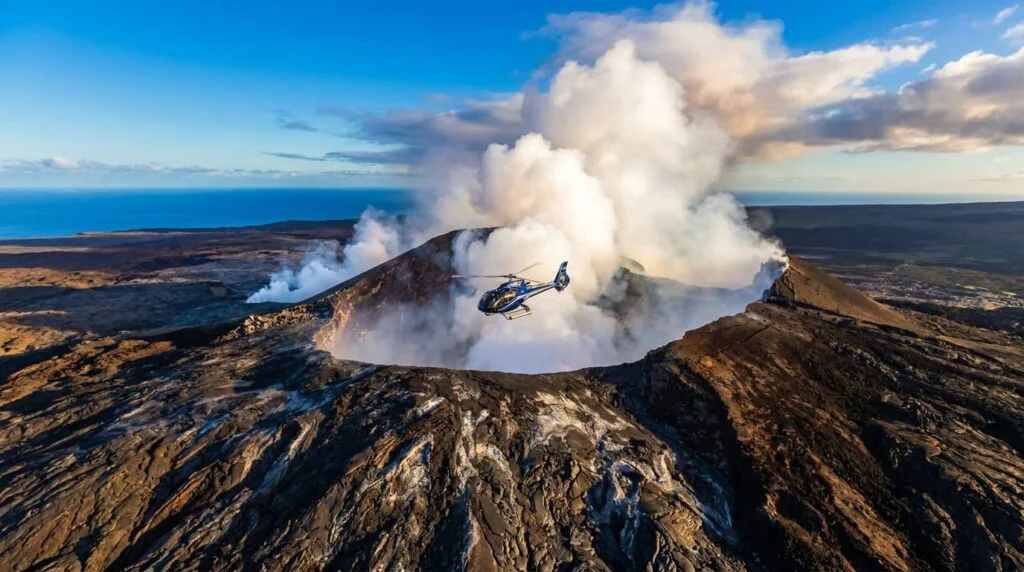
Here is the single most common disappointment on the Big Island: someone books a volcano tour, spends nine excellent hours in the park, sees craters, steam vents, lava tubes and hardened flows — and comes home saying they never saw anything glowing. They were there. They were just there in daylight.
Quick Answer: Crater glow is only visible after dark. Molten rock radiates orange light constantly, but daylight overwhelms it completely, so daytime volcano tours structurally cannot show it. The Evening Volcano Tour from Kona is $295.99 per adult and child and is built around being in the park at nightfall.
TL;DR
- Why evening: Glow is drowned out by daylight, not absent from it
- The tour: Evening Volcano Tour from Kona, $295.99 per adult and child
- The other night option: Sunset and manta ray snorkel combo, $135.00 per adult
- Best window: The hour after sunset, before your eyes adjust to full dark
- Caveat: Glow requires active lava at the surface — check conditions before booking
Glow is always there. Daylight simply wins.
Molten rock sits somewhere around 2,000°F and radiates visible orange light continuously. It does not switch on at dusk. What changes is the competition.
Direct sunlight is roughly a hundred thousand times brighter than the glow coming off a crater. Against that, the light is simply not detectable — the same reason you cannot see stars at midday even though they have not moved.
After sunset the contrast inverts, and a crater that looked like grey rock at 3:00pm reads as a pool of orange light at 7:30. Nothing about the volcano changed in those four hours. Everything about your eye did.
This is why we keep a separate page on whether you can see lava right now — the answer depends on both the eruption and the hour.

The evening tour from Kona
The Evening Volcano Tour from Kona is $295.99 per adult and child, and it is structured backwards from most volcano itineraries. Instead of arriving at the park in the morning and leaving mid-afternoon, it arrives late and stays through nightfall.
The Kona departure is not an accident either. From the west side, the drive to the park is over two hours — which is dead time on a morning tour, but on an evening tour it is simply how you spend the afternoon while waiting for the light to go. The geography that makes Kona a poor morning departure makes it a natural evening one.
Coffee country on the Hualalai slopes sits directly on that route, which is why most evening itineraries include a stop there rather than treating it as a detour.
For morning departures the calculus reverses entirely — see Kona versus Hilo.
Kona’s other after-dark booking
The Sunset and Manta Ray Snorkel Combo at $135.00 per adult runs on the same principle from the water rather than the land. You board in daylight, watch the sun go down from the boat, and then get in over lights that draw plankton, which draw manta rays.
Manta rays here have wingspans that commonly reach twelve feet. They arrive within a couple of feet of the surface and they barrel-roll through the plankton bloom directly beneath floating snorkellers. It is one of the few genuinely reliable wildlife encounters in Hawaii — the animals are resident, not migratory.
We have written the full briefing in our manta ray night snorkel guide.
Both products exist for the same structural reason: the Kona coast is where the Big Island’s best experiences happen after the sun has gone.
What an evening in the park actually feels like
The temperature is the first surprise. The summit sits near 4,000 feet and drops hard after sunset — fifty degrees is normal, and the wind on an exposed overlook makes it feel colder. People arrive from a beach day in Kona dressed for Kona.
The second is how dark it genuinely gets. There is very little ambient light on this part of the island, which is exactly what makes the glow readable and also means a headtorch with a red mode is worth carrying. White light kills your night vision for several minutes and annoys everyone around you.
The third is the sound. The park is quiet in a way that daytime visitors never experience, and steam vents that are visually unremarkable at noon are audible at night.
If you would rather walk the terrain in daylight and come back for the glow, hiking Kilauea covers the crater floor trails, and private volcano tours can be scheduled to run late.
The honest caveat
Evening timing removes the daylight problem. It does not create lava.
If Kilauea is not actively erupting, there is no glow to see at any hour, and no operator can change that. What an evening tour reliably delivers even in a quiet period is the park after dark — the crater rim under an exceptional night sky, steam vents lit from below, and a version of the landscape that daytime visitors simply do not get.
Check current activity before you book rather than after. Our complete park guide sets out how the eruption cycle affects what is visible.
Booking notes
Layers, not a jacket. You will leave Kona at 80°F and stand at the crater rim near 50°F.
Red-mode headtorch. Preserves night vision and makes you a better companion on a dark overlook.
Eat before, or bring food. Park food service is minimal and largely closed by evening.
It is a late finish. A Kona evening tour returns well after dark, which is worth checking against a morning flight.
Good for couples, harder for small children. The late hours and the cold are the constraint rather than the terrain. Both of these tours also feature in our honeymoon experiences guide.
Photography via Vecteezy.
Frequently Asked Questions
Why can you only see crater glow at night?
Because daylight is roughly a hundred thousand times brighter than the light molten rock gives off. The glow is present all day but undetectable against the sun, in the same way stars are still overhead at noon. After sunset the contrast inverts and the same crater reads as orange light.
How much is an evening volcano tour on the Big Island?
The Evening Volcano Tour from Kona is $295.99 per adult and child. It is built backwards from a standard itinerary, arriving at the park late in the day and staying through nightfall rather than leaving mid-afternoon.
Is there a cheaper after-dark option?
The Sunset and Manta Ray Snorkel Combo is $135.00 per adult. It runs from the Kona coast rather than the park, pairing sunset on the water with a night snorkel over lights that attract manta rays with wingspans commonly reaching twelve feet.
Will I definitely see glowing lava on an evening tour?
No. Evening timing removes the daylight problem but cannot create an eruption. If Kilauea is quiet there is no glow at any hour. What the tour reliably delivers is the park after dark, which daytime visitors never experience.
What should I bring on an evening volcano tour?
Layers, because the summit near 4,000 feet drops to around 50°F after sunset while Kona stays near 80°F. A headtorch with a red mode preserves night vision. Food, because park services are minimal and largely closed by evening.
Is an evening volcano tour suitable for children?
The terrain is fine but the hours and the cold are demanding. The tour is priced for adults and children, so it is permitted, but families with young children generally do better on a daytime park visit.
Prices checked against operator listings, September 2026. Availability and rates are set by the operator and can change.
See the crater when it actually glows
Evening volcano tours from Kona at $295.99, or sunset and manta rays from $135.00.
Browse Big Island evening tours · Evening Volcano Tour from Kona · (808) 207-9427