Hawaiian Activities — island tours, luaus, and adventures across Oahu, Maui, Kauai, and the Big Island.
Two hours, a board longer than you are tall, and about twenty minutes of it on dry sand before you go anywhere near the water. Here is the whole thing, start to finish.
Quick Answer: A lesson runs 90 minutes to 2 hours: paperwork, a 15–20 minute beach briefing practising the pop-up on sand, a safety talk, then 60–90 minutes in the water. Most people stand up on day one because the instructor pushes you into the wave. Bring reef-safe sunscreen, secure swimwear, and a towel.
TL;DR
- 90 min–2 hrs total, with 20 minutes of it on dry sand first
- Big soft-top boards — 9–10 feet, because volume equals stability
- The pop-up is everything: one motion, never via your knees
- Commonest error: standing too early, before the wave takes the board
- Most beginners stand in the first lesson
- Private lessons get you roughly triple the waves of a group
Before You Get in the Water
A typical lesson runs 90 minutes to two hours, and a surprising amount of it happens on dry sand. Expect roughly:
- Sign-in and sizing (10 min). Waivers, then a board matched to your height and weight. Beginners get big soft-tops — often 9 to 10 feet. They look comical and they are correct: volume equals stability.
- Beach briefing (15–20 min). How to lie on the board, where to put your hands, how to pop up, and — importantly — how to fall.
- Safety (5 min). Rip currents, right of way, how to protect your head when you come off.
- In the water (60–90 min). The actual surfing.
The sand section can feel like a delay when the ocean is right there. It is not. Practising the pop-up on a stationary board is how the movement gets into your body before you try it on something moving.
The Pop-Up, Which Is the Whole Game
Everything else is detail. The pop-up is one continuous movement, not a sequence of poses:
- Paddle until you feel the wave lift and carry the board.
- Hands flat under your chest, elbows in — not out to the sides.
- Push up and swing your feet through in one motion. Do not go via your knees; knees are a habit that takes weeks to unlearn.
- Land with feet across the board, roughly shoulder-width, knees bent, weight low.
- Look where you are going, not at your feet. Looking down puts your weight forward and the nose goes under.
The most common beginner error is not strength or balance — it is standing up too early, before the wave has properly taken the board. Wait the extra half-second for the wave to do the work.
What It Actually Feels Like
Harder than it looks, and more achievable than you fear. Paddling uses shoulder muscles most people never use, and you will feel it the next day. Saltwater will go up your nose. You will fall repeatedly, which is fine — falling flat and shallow is the technique, never diving head-first, and always surfacing with your arms covering your head in case the board is above you.
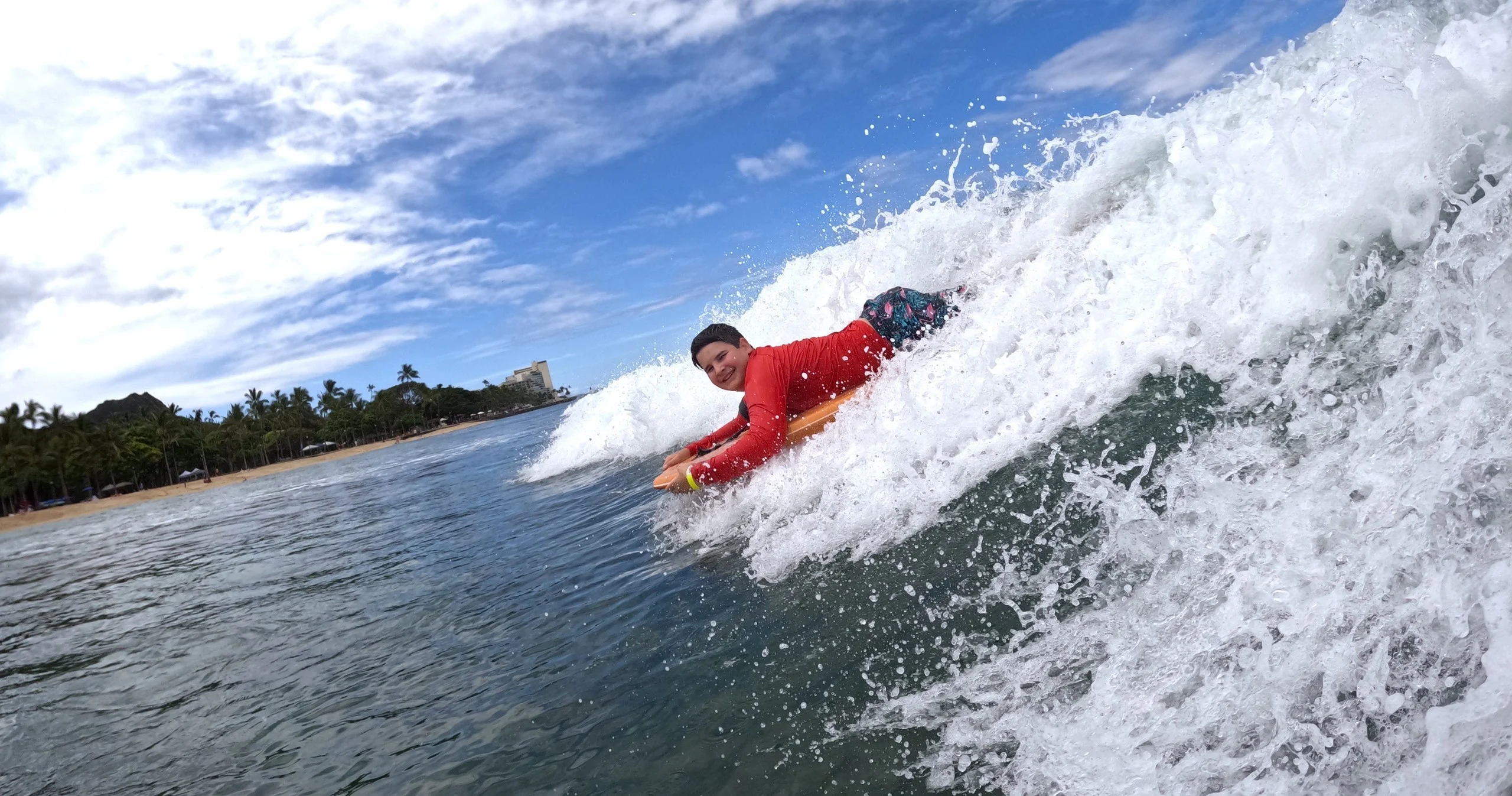
And then a wave picks the board up, you get your feet under you, and you are moving toward the beach at a speed you did not generate. That first ride is usually about four seconds long and people remember it for decades.
Most people stand up in their first lesson. Instructors push you into the wave, which removes the hardest part — catching it — so what is left is the pop-up, and that is learnable in an hour.
What to Bring and Wear
| Item | Notes |
|---|---|
| Swimwear | Something secure. One-piece or a tied bikini; boardshorts with a drawstring |
| Rash guard | Usually provided. Prevents board rash on chest and ribs — a real thing |
| Reef-safe sunscreen | Required by Hawaii law. Apply 30 minutes before, face and back of neck especially |
| Towel and change of clothes | You will be completely soaked |
| Water | You will not notice dehydration in the ocean |
| Leave behind | Loose jewellery, watches, contact lenses if you can manage without |
Board and leash come with the lesson. Wetsuits are almost never needed — Hawaiian water sits around 24–27°C year-round.
Group or Private?
Group lessons are cheaper and sociable, typically 4–6 students to one instructor. They work well for confident, reasonably athletic people who do not need much individual attention.
Private lessons cost more and are worth it if you are nervous, over 50, under 10, recovering from injury, or simply want more waves — with one instructor to yourself you get roughly triple the wave count. In crowded water like Waikiki, that difference is even larger.
A standard Oahu surf lesson covers all levels with gear included, while a Private Surf Lesson puts one instructor entirely at your disposal. On Kauai, there is a private one-on-one lesson and a group lesson at Poʻipu Beach.
“Nobody has ever regretted booking the private lesson. Plenty of people have spent a group lesson waiting their turn and wondering why they only caught four waves.”
Etiquette Worth Knowing
You will be in shallow beginner water, but these apply everywhere and mark you out as someone worth having around:
- One surfer per wave. Whoever is closest to the breaking part has priority.
- Do not drop in. Taking off on a wave someone is already riding is the cardinal sin.
- Hold on to your board. A loose board is a hazard to everyone behind you.
- Paddle around the break, not through it.
- Respect local surfers. You are a guest in their water. Friendly, unhurried and unobtrusive goes a long way.
After the Lesson
Expect sore shoulders, a sunburnt spot you missed, and a strong urge to book again. If you want a second session, go the next day rather than later in the trip — the movement is still in your body and the progress jump is significant.
Not sure where to book? Our comparison of Waikiki versus the North Shore covers which coast suits which season. Browse Oahu surf lessons, Kauai surf lessons, or the full Oahu range.
Frequently Asked Questions
How long is a beginner surf lesson?
Typically 90 minutes to two hours, including 15–20 minutes of dry-land instruction before you enter the water.
Will I be able to stand up on my first surf lesson?
Most people do. The instructor pushes you into the wave, which removes the hardest part, leaving just the pop-up to learn.
What should I wear to a surf lesson in Hawaii?
Secure swimwear, plus reef-safe sunscreen — required by Hawaii law. A rash guard is usually provided, and wetsuits are not needed.
Is surfing hard to learn?
The first ride is easier than expected; genuine competence takes much longer. Paddling is the tiring part and uses muscles most people rarely engage.
Should I book a group or private surf lesson?
Private if you are nervous, very young or older, injured, or simply want more waves — roughly triple the wave count. Group lessons suit confident, athletic beginners.
Book the lesson. Catch the wave.
Group and private surf lessons on Oahu and Kauai — boards, leashes, rash guards and instruction included.
Oahu Surf Lessons · Kauai Surf Lessons · All Activities · (808) 207-9427
Disclaimer: ocean conditions vary daily and surf size can change within hours. Always follow lifeguard advice and your instructor’s guidance, disclose any medical conditions or injuries when booking, and never surf alone as a beginner.